

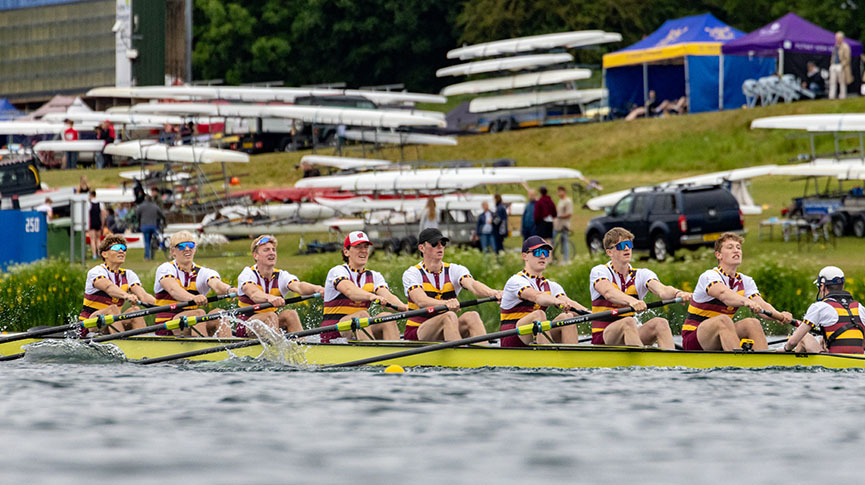
The course at the National Water Sports Centre is a 2,000-metre straight cut by a forest on one side and a grandstand on the other, six lanes wide and pointed almost due south. Two and a half thousand athletes will line up on it Friday through Sunday. The Championship 1st VIII Final at National Schools' Regatta is, in the United Kingdom, what the Stotesbury or the SRAA varsity Final is in the United States: the one race that decides whose season this was.
The Rowing Power Index is publishing its first set of British crew rankings today — three days before any of them race a 2,000m at NSR, and ahead of the rest of the British scholastic championship calendar. This piece is preview only. There are no NSR results yet; the tables below reflect what the model knows from the Schools' Head of the River Race in March and from the spring fixtures season since.
A different calendar, a different shape of data
The UK race book has one structural feature the US one doesn't: a national, processional, every-crew-of-consequence-on-the-same-morning regatta in March, four and a quarter miles down the Tideway, called the Schools' Head of the River Race. It is where the British season's cross-region question gets answered before anyone has raced a side-by-side 2,000. Then a regional fixture season runs from late April through the National Schools', Henley Royal Regatta, and Henley Women's Regatta over the back half of the spring.
The American calendar, by contrast, runs almost entirely inside regional leagues until Stotesbury and the SRAA in mid- to late May. The British scholastic season front-loads its cross-region data. The American one back-loads it.
What the model does with that difference: it leans on the 2026 Schools' Head result as a strong prior — the cleanest single piece of British cross-region data available — and updates on the regional and invitational results that have followed. The British rankings end up with wider 90% intervals than the US ones did at the same stage in the season, and a model honest about the fact. This piece is preview-led; the rankings sit inside the storylines, not above them.
What Schools' Head produced
Boys' Championship 1st VIII (March 13, four and a quarter miles, Tideway, processional):
| Pos | Team | Time | RPI Δ |
|---|---|---|---|
| 1 | Shiplake College | 16:49.80 | - |
| 2 | St. Pauls | 16:52.70 | - |
| 3 | Radley College | 16:54.00 | - |
| 4 | Hampton School | 17:00.40 | - |
| 5 | Kings College | 17:02.90 | - |
| 6 | Westminster | 17:06.60 | - |
| 7 | Bedford | 17:12.30 | - |
| 8 | St. Edwards | 17:15.20 | - |
| 9 | Shrewsbury | 17:22.10 | - |
| 10 | Abingdon | 17:26.70 | - |
| 11 | Dulwich College | 17:26.80 | - |
| 12 | Latymer Upper | 17:30.30 | - |
| 13 | Eton College | 17:33.80 | - |
| 14 | Reading | 17:34.10 | - |
| 15 | Norwich | 17:37.00 | - |
| 16 | Tideway Scullers | 17:52.80 | - |
| 17 | Aberdeen | 18:13.30 | - |
| 18 | Monmouth | 18:19.00 | - |
| 19 | Brentford | 18:53.80 | - |
Girls' Championship 1st VIII (March 20, same course):
| Pos | Team | Time | RPI Δ |
|---|---|---|---|
| 1 | Shiplake College | 18:21.60 | - |
| 2 | Headington | 18:33.10 | - |
| 3 | St. Edwards | 18:48.20 | - |
| 4 | Lady E Holles | 18:56.80 | - |
| 5 | Latymer Upper | 19:00.40 | - |
| 6 | St. Pauls Girls' | 19:11.20 | - |
| 7 | Godolphin | 19:23.80 | - |
| 8 | Surbiton High School | 19:23.90 | - |
| 9 | Tideway Scullers | 19:28.50 | - |
| 10 | St. Michaels | 19:48.00 | - |
| 11 | Nottingham & Union | 20:07.00 | - |
| 12 | Brentford | 20:37.20 | - |
| 13 | Trentham | 20:52.10 | - |
The dominant single piece of British data on the model's books in 2026 is the same crew winning both Heads — Shiplake College over the boys' field by 2.9 seconds, and the Shiplake girls over Headington by 11.5. The boys' top three sat within 4.2 seconds of each other across four and a quarter miles of moving water; the boys' top six sat inside 17. That is the cluster the model has been weighing for two months.
The boys' Championship 1st VIII — top ten
St. Paul's head the boys' table at RPI 2036 — the highest British men's V8+ rating on this site and, on the model's reading, the rating-favourite for the Championship 1st VIII Final at the National Schools'. They lost the Schools' Head to Shiplake by 2.9 seconds across four and a quarter miles; the model puts the difference between a processional time-trial of that length and a multi-lane 2,000m at enough that Shiplake's faster head-race result and St. Paul's stronger fixtures season since produce different rankings. The interval at the top (1941–2136, 195 points) is wider than the model's strongest US top-of-table interval but tighter than the British prep schools' general spread; it reflects the depth of British data the model has and the limits of what March-and-fixtures alone can resolve.
The middle of the table — Hampton, Radley, Shiplake, Westminster, King's College, Eton — sits inside 50 RPI points top to bottom. The intervals overlap meaningfully; the order is the rating's best read, not its strong claim. A Championship Final at NSR that runs the historical six-in-five-seconds shape will close the cluster from inside out.
The model's note on Shiplake specifically: their interval (1778–2090, 312 points) is the widest in the top ten. Schools' Head winner and a thinner spring fixtures record — the rating won't reward the headline result with a tight number until more 2,000m data lands. NSR is, for them more than for any other crew on the boys' table, the regatta where the interval either contracts toward the top or fans toward the cluster.
The girls' Championship 1st VIII — top eight
| 1 | 1983 | |
| 2 | 1945 | |
| 3 | 1876 | |
| 4 | 1772 | |
| 5 | ▲1 | 1737 |
| 6 | ▼1 | 1730 |
| 7 | ▲1 | 1642 |
| 8 | ▼1 | 1595 |
The British girls' table runs to eight rather than ten — Lady Eleanor Holles and Godolphin both sit below the model's four-race threshold for the public table on the strength of the spring fixtures calendar each has run so far. Their ratings exist on their team pages, with the appropriate caveats. They will lift into the public ranking when the racing earns it; for several of them, NSR is the regatta where it does.
Headington lead the girls' table at RPI 1983 with the tightest interval (1932–2037, 105 points) of any British crew on either side of this preview. Schools' Head silver to Shiplake by 11.5 seconds, a long fixtures record across the spring, and the cleanest data shape in the British women's data the model has. The reading is the rating's most confident British statement on either gender.
Shiplake sit at #2 on the back of the Schools' Head girls' win — 11.5 seconds clear of Headington over four and a quarter miles, the cleanest single piece of cross-region British data on either side of the regatta. RPI 1945; interval 1889–2003. They are the only school programme that won both Schools' Head brackets in 2026, and the only school programme inside the top four of both the boys' and the girls' tables here. NSR is the regatta where that consistency either holds, splits between brackets, or unwinds.
The gap from Shiplake (#2) to St. Edward's (#3, RPI 1876) is 69 RPI points — the cleanest top-three separation in either British table. Below that the cluster widens. The girls' Championship 1st VIII at the National Schools' has, over the past three seasons, settled less cleanly than the boys'. The Schools' Head field is fewer crews and a less complete picture. The model's intervals reflect that; the boats below the top three on this table are less separated than the boats inside it.
A methodology note
The rating that powers this site was built around US race data through April. Adapting it to the British calendar required two changes. First, the Schools' Head result is weighted differently from a standing-start 2,000m of the same field strength — a processional time-trial against four and a quarter miles of identical water is more informative about boat speed than a six-lane 2,000m on a windy day, but less informative about racing pattern under pressure. Second, the boat class prior was rebuilt from the smaller body of historical British scholastic data the model has access to. The result is a rating with wider intervals than the US rankings, and a model publicly honest about the size of its own uncertainty.
The full methodology piece — written for the US launch in April — is here. The British rating uses the same RPI mechanism, the same four-digit scale anchored around 1500, the same 90% interval reporting, and the same rule that a crew with too few rated races does not appear on the public table. What's different is the depth of the input data, and the model is reporting that difference rather than hiding it.
How NSR works
Three days of racing, three rounds of selection. Time-trial heats on Friday — the field rowing the 2,000m course one boat at a time against the clock, with the fastest times advancing to side-by-side semifinals on Saturday. Six-lane Championship A Finals on Sunday afternoon. The Championship Boys' 1st VIII A Final and the Championship Girls' 1st VIII A Final are typically scheduled within an hour of each other on the Sunday, around the middle of the afternoon. The rating's largest single update of the regatta weekend is on the Sunday-evening rankings page after both Finals have run.
The course itself sits at the bottom of a shallow valley parallel to the River Trent. Wind tends to come over the trees from the east in the morning and turn south-westerly in the afternoon; a southerly tailwind shortens times by several seconds in the eight, a southerly headwind lengthens them by more. The rating treats time differences inside a single race as informative and time differences across races on the same course as caveated — Sunday afternoon Finals run in different conditions from Saturday morning heats, and the model reads them accordingly.
What the model is watching
Three storylines decide the British rankings' shape over the next four days.
The boys' top three. St. Paul's, Hampton, and Radley sit inside 100 RPI points at the top of the boys' table; Shiplake carry the Schools' Head win and the widest interval. A Sunday Final inside the historical six-in-five-seconds band tightens this group meaningfully and decides whether the rating-favourite or the head-race-favourite holds at #1 in the next refresh.
The girls' top two. Headington and Shiplake are inside 40 RPI points with overlapping intervals. A clean A Final result — either way — produces the model's most confident British women's statement of the year.
The Championship 2nd VIII A Finals on Sunday morning. The model uses 2nd VIII A Final results to confirm the depth of a programme rather than the speed of any single boat. Programmes with strong 2Vs at NSR are the programmes whose 1V ratings tend to hold cleanly into Henley Royal and Henley Women's. The 2V Final shapes how the rating writes the next six weeks of British prep school racing.
Henley Royal Regatta is the next big event after this one. The Princess Elizabeth Challenge Cup (boys' 1st VIII) and the Diamond Jubilee Challenge Cup (girls' 1st VIII) sit five weeks past NSR weekend. The British rankings, like the US ones, get their tightest version of themselves at the end of the season. For the next four days — and on the Sunday evening after the Finals — the model's reading is what these pages publish here.