
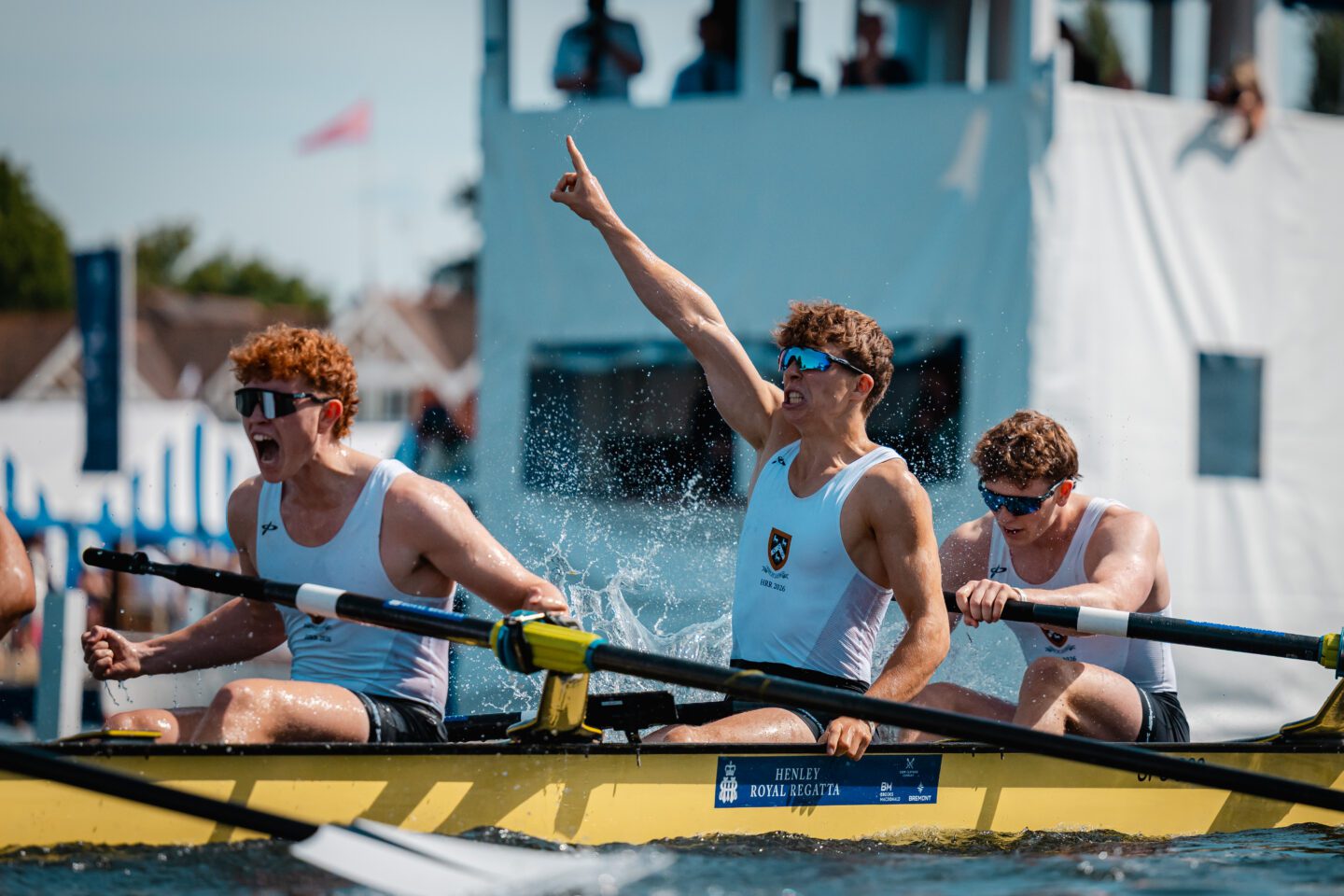
St. Paul's won the Princess Elizabeth Challenge Cup on Sunday afternoon, beating St. Edward's by two-thirds of a length in 6:20. Five races, five wins, never headed. They finish the season as the highest-rated men's eight on this site.
That second sentence took rather longer to arrive than the trophy did, and it is the more interesting of the two.
| Pos | Team | Time | RPI Δ |
|---|---|---|---|
| 1 | St. Pauls | 6:20.00 | - |
| 2 | St. Edwards | 6:22.05 | - |
The Final
| Crew | Time | Verdict |
|---|---|---|
| St. Paul's 🇬🇧 | 6:20 | — |
| St. Edward's 🇬🇧 | 6:22 | ⅔ length |
The clock is the quiet story of that race. St. Paul's went 6:20, two seconds slower than the 6:18 that beat Radley on Saturday. St. Edward's went 6:22, seven seconds faster than their own semi-final and their second-quickest trip of the week. The crew that was supposed to be running out of regatta was still finding time on the last afternoon, and the gap on Sunday was two-thirds of a length: close enough that the enclosures were standing, clear enough that nobody argued.
On the ratings the model carried into Sunday, this was not a close Final — a hundred and seventy-one points, two credible intervals that did not overlap anywhere. Two-thirds of a length is not a hundred-and-seventy-one-point performance. The distance between what the numbers expected and what the river produced is the thread running through this entire regatta, and it is worth pulling.
St. Edward's, the crew of the regatta
St. Edward's at Henley 2026. Ninth of the sixteen survivors after Day 1, on the model's numbers. Beat Phillips Exeter — the model's pick — by 1½ lengths. Beat Enniskillen Royal by 1½. Beat Shiplake College — the model's pick, by 116 points — by a canvas, in 6:17, the fastest winning time of the week. Beat Kings College — the model's pick, by 93 points — by 2¼ lengths. Lost the Final by ⅔ of a length. Five races, four wins, three of them over the crew the rating preferred.
A model that had been told the answer in advance would have rated St. Edward's somewhere near the second-best crew in this field. It was not told the answer in advance, and it rated them eighth of the last eight. The distance between those two statements is the honest measure of what a rating built on spring schools racing does and does not know about a June knockout on the Thames.
The scorecard: six days, thirty-one races
The Princess Elizabeth ran thirty-one races. Seven of the thirty-two starters arrived without a rating — five overseas or club entries and two British schools the model had not seen race this season — and the six Round-of-32 heats they appeared in gave it no opinion to be right or wrong about. That leaves twenty-five races where it made a call, each judged against the last fit published before that round.
| Round | Races called | Correct | Misses |
|---|---|---|---|
| Round of 32 | 10 | 8 | Phillips Exeter (17 pts), Claires Court (2 pts) |
| Round of 16 | 8 | 6 | Deerfield (67 pts), Shrewsbury (18 pts) |
| Quarter-finals | 4 | 3 | Shiplake (116 pts) |
| Semi-finals | 2 | 0 | Radley (10 pts), Kings College (93 pts) |
| Final | 1 | 1 | — |
| Total | 25 | 18 | 72% |
Seventy-two per cent is a respectable but unspectacular number, and the way to read it is by margin rather than by count. Four of the seven misses were races the model itself had priced at under twenty points — Exeter, Claires Court, Shrewsbury and the Radley semi-final all sit inside the range where the rating was explicitly declining to pick a winner. Strip out every race priced inside twenty points, in both directions, and it went seventeen from twenty on the races where it claimed to know something: eighty-five per cent.
The three real misses are worth naming, because they are not random:
- Deerfield losing to Kings College by two and a quarter lengths. The model had the Americans priced too high all spring, and Henley marked that to market on consecutive days — Exeter on Tuesday, Deerfield on Wednesday. Every US crew that entered was beaten by a British or Australian one.
- Shiplake losing to St. Edward's by a canvas, 116 points the wrong way.
- Kings College losing to St. Edward's by two and a quarter lengths, 93 points the wrong way.
Two of the three have the same crew in them.
Where the ratings settle
A note on the numbers below. These are the men's eights ratings as they stand after the model correction that shipped in August — not the provisional figures published in the days immediately after the regatta. Where the two disagree, these are the ones this site stands behind.
The Princess Elizabeth field, on the settled numbers:
| # | Crew | RPI | 90% interval |
|---|---|---|---|
| 1 | St. Paul's 🇬🇧 | 2134 | 2078–2188 |
| 2 | Radley College 🇬🇧 | 2107 | 2056–2158 |
| 3 | Shiplake College 🇬🇧 | 2044 | 1995–2093 |
| 4 | Kings College 🇬🇧 | 2023 | 1981–2067 |
| 5 | St. Edward's 🇬🇧 | 2008 | 1960–2057 |
| 6 | Hampton School 🇬🇧 | 2007 | 1962–2056 |
| 7 | Deerfield 🇺🇸 | 2002 | 1962–2043 |
| 8 | Westminster 🇬🇧 | 1994 | 1945–2046 |
| 9 | Sydney University 🇦🇺 | 1985 | 1916–2056 |
| 10 | Bedford 🇬🇧 | 1977 | 1930–2023 |
Three things fall out of that table.
The champion is on top. St. Paul's end the year as the highest-rated men's eight on the site, twenty-seven points clear of the crew that pushed them hardest. A rating that scores margins rather than trophies is under no obligation to agree with the result; that it does here is a fact about the racing, not a courtesy.
The event owns the table. The seven top-rated men's eights this model can see all raced this regatta — not the top seven British crews, the top seven full stop, ahead of every American and Australian boat on the site. The best-placed eight that did not enter is eighth.
Nobody at the top is separable from their neighbour. Every interval in that top seven overlaps the one below it, and a hundred and thirty-two points covers the whole group. St. Edward's at 2008 and Hampton at 2007 are, as far as the model is concerned, the same crew. That is not vagueness for its own sake. It is the width of the thing these ratings are actually measuring, printed honestly.
Radley, second and not wrong
Radley led this table from National Schools' to the semi-finals, won every race at Henley except one, and lost that one by a length. They finish second, twenty-seven points back, with an interval that overlaps the champion's across most of its length.
That is the correct answer rather than a consolation. The model's read on the Radley–St. Paul's semi-final was ten points — a coin flip on a four-digit scale — and a coin flip that lands is not evidence about which side was heavier. What separates the two crews at the end of the year is not that one race; it is the extra Final St. Paul's went on to win, and the margins accumulated across the whole spring. Twenty-seven points is a narrow, well-earned gap, and the honest reading of Henley 2026 is that these two crews spent the season inside each other's error bars and finished there.
The brackets
Eighteen entries were submitted to the PE Cup bracket before racing began. Eleven of them picked Radley to lift the trophy. Three picked Deerfield. One each went for Hampton and Shiplake. Exactly one entry picked St. Paul's — Brian Kilner's — and it won the pool with 33 points.
One entry out of eighteen had St. Edward's reaching the semi-finals. None had them in the Final.
What the model learned, in three sentences
St. Paul's won the Princess Elizabeth by two-thirds of a length over a crew the ratings had priced a hundred and seventy-one points below them, and they end the season as the model's top-rated men's eight — trophy and table agreeing, in the end, about a regatta that spent six days arguing with the numbers. Across those six days the model called eighteen of twenty-five races correctly, and eighty-five per cent of the ones where it claimed a real edge, and of the seven it got wrong, three were the same crew beating the favourite: St. Edward's, who rose from eighth of the last eight to fifth in the settled table. The durable lesson is about width rather than order — the seven best eights in this model all raced this event, a hundred and thirty-two points covers the lot of them, and every one of their intervals overlaps its neighbour's, which is the model saying, correctly, that Henley was closer than any pre-race number made it look.